


Drawing lines
Dramatic landscapes with a side order of ski action are the foundation of Christoph Oberschneider’s unique style of photography. His plan was to work as a medical doctor, but the mountains got in the way.
[Feature story from the Field Book Issue #002]
Being a ski and outdoor photographer is a dream job, a way to turn your passions into a profession and make a living without getting caught up in the rat race of “normal” society. You get to travel to exciting places, and do creative work in the great playground of nature.
At the same time, a freelancer’s existence can be stressful at times. Always scrambling for work, not always having a fixed income, and having to deal with the insecurities of lacking steady employment. It’s not for everyone; it takes a certain personality to make it work. Having an education or a “normal” job to fall back on if things go south can be a good thing – at the very least, it can help keep you sane in times of uncertainty.
To Austrian photographer and The Mountain Studio ambassador Christoph Oberschneider, that fallback profession is practicing medicine. The native of Salzburg, Austria, studied medicine in Graz, finished his degree, and was well on his way to pursuing a career as a doctor. But around that time, photography came into his life, and his plans were soon sidelined as he embarked on a path of discovery that took him to the mountains of the world.

How do you balance photography with being a doctor?
– Technically, I’m a medical doctor, but I never really started working as one because photography sort of got in the way. Unfortunately, combining medicine and photography proved to be impossible, even though I did try to combine my two passions by taking work as a medical lecturer in the off season a few years back. That was never really an ideal solution, though. I couldn’t make it work, and I decided to focus on photography.

How did you get into photography in the first place?
– I’ve always been in love with skiing, ever since I started at the age of three, and everyone else in my family is the same. Originally, I wasn’t really interested in backcountry skiing. I was more of a wannabe ski racer, and I loved laying down fast, carving turns on the piste. Obviously, that changed at some point, and when my brother and I – I have 4 younger siblings – got into freeriding, I was eager to capture the action and the soul of skiing.
– I wanted to create a short freeride video and show what it was like to ski deep powder in our home resort of Gastein in Austria. But the compact cameras and early GoPro action cameras I was using weren’t really up to the task, so eventually, I bought my first proper camera with some older lenses.


Are you still creating videos?
– To make a long story short. I soon realised that it was both easier and more rewarding for me to shoot stills instead of video, and that’s basically how my career as a photographer started.
– I captured the action skiing with friends, landed my first paid shoots for a few different companies, and, luckily enough for me, this soon evolved into a full-time job. My background as a skier helped me anticipate and plan my shots, as well as making me aware of alpine risks and giving me the ability to ski practically any line myself, even with a heavy camera backpack.
– That said, I still shoot some videos for work.


What is your style of photography?
– My style of photography has changed a lot since I started out. Back then, I was always shooting with a super tele lens, like a 100-400 mm, and tried to get those classic, close-up powder shots that we’ve all seen in ski magazines since forever. I still love doing that, but I’ve come to also want to incorporate the surrounding landscape into the shot.
– Doing that allows me to tell a story in the photo, like how the skier decided to ski his line, where he started, or whether there were other options available to him. Close-up shots don’t tell that story, although, of course, they can reveal the emotions of the skier.


Drone images seem to be a big part of your photography. Why is that?
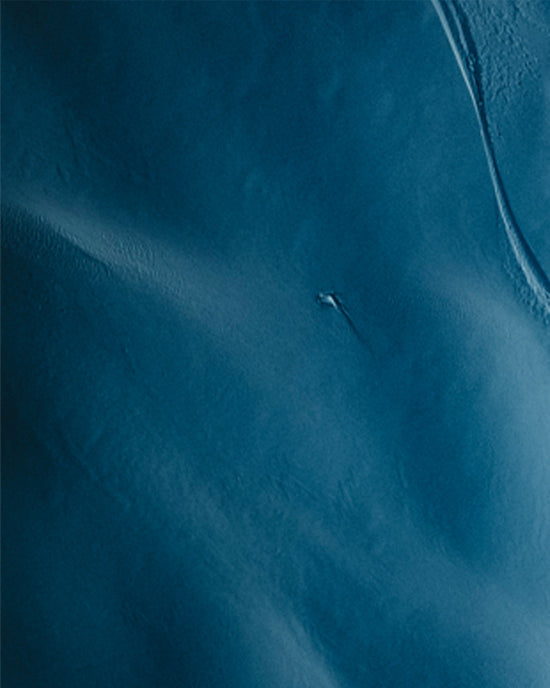
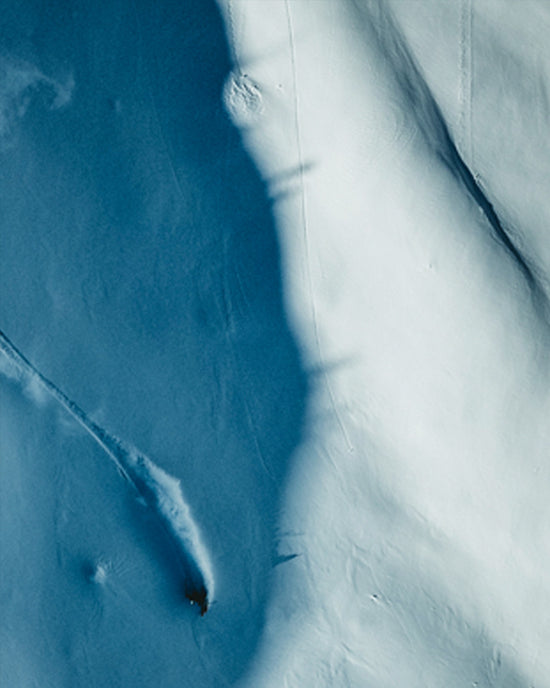
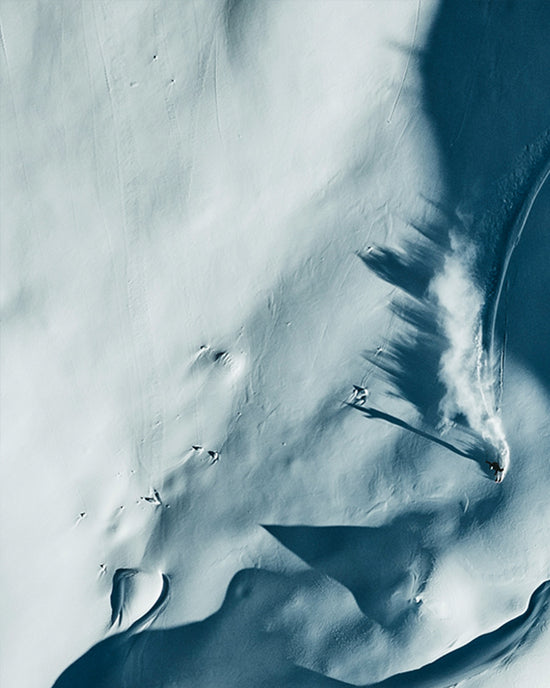
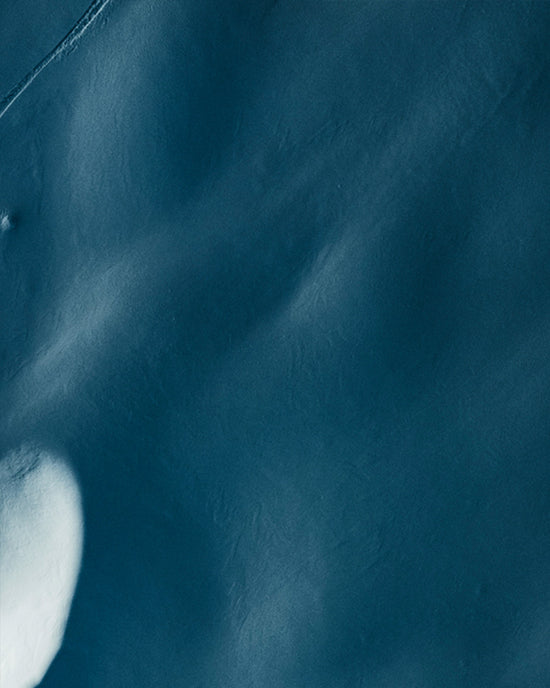
– That’s correct, I’m a huge fan of aerial photography. My favourite shots are top-down shots that are sort of minimalistic and focus on the art of drawing lines in the snow – ideally, in combination with long, dramatic shadows. The idea of getting shots like that is what motivates me to keep pushing myself.
– Looking back at my early days of working with aerial photography, I remember having to ski with two backpacks: one for my drone and one for my big camera. Thankfully, with the invention of foldable, compact drones, this has become a thing of the past.

Photography can easily turn into a game of carrying the most gear on the mountain, can’t it?
– When I started, I was only using zoom lenses, mostly because I was afraid I might miss a shot if I was using fixed lenses. Nowadays, though, my zoom lenses are mostly collecting dust, and all I care for is getting the shot with a fast prime lens such as a 16, 35 or 135 mm. The only zoom lens I still use is the 70–200.
– That encourages me to get creative whenever I’m too close to or too far from my subject, and I love that challenge. With zoom lenses, I always tend to frame the image in an ideal way, so that the subject is positioned not too far from the centre, with plenty of space available. Rather than moving to get closer or further away, I just change the focal length. Obviously, you can’t do that with a prime lens, which makes it a lot more challenging to get the shot right: I either have to “zoom” in or out with my feet or – if that’s not an option – try to find a way to frame the subject from too close or too far away that still gives me an interesting composition.


What’s your favourite place to ski and shoot photos?
– I mostly ski in and around Bad Gastein. My parents have a flat there where I can stay during the winter season. There’s a little secret spot hidden in a well-known freeride area of the Gastein valley, where the terrain is incredibly playful. I’d say that’s my favourite place to ski in my home area.
– As far as my favourite place to photograph, I guess that would have to be anywhere where I can find a dramatic landscape buried in deep snow. A few favourites of mine are the Pale di San Martino in Belluno, Italy, the high alpine peaks of the High Tauern in Austria, or the majestic peak of Watzmann, which is close to my home.

What does the future hold for Dr Oberschneider and his camera?
– As a photographer, I’m always looking for new angles, for new ways to capture the action or that special moment. My sense of excitement and anticipation about what lies ahead is what drives me. I look forward to seeing, and photographing, new places, exploring them with like-minded people, making new friends along the way, and – as I’ve been able to so far in my career – making a living doing what I love!
